 The Belizean Jungle and the Mayan ruins of Lamanai had always been an area I longed to see ever since I did an Essay in high school on the Mayan Civilization. As soon as I was old enough to travel on my own, I'd booked a trip to the Yucatan Peninsula. I explored the whole coast, all the way down to Tulum, experienced some fantastic bird watching in the Sian Ka'an Biosphere (the UNESCO World Heritage site) on the east coast of the Yucatan Peninsula, and then wandered around in awe in Tikal, one of the largest archeological sites of pre-Columbian Maya civilization in Guatemala. It took my breath away and ignited a spark in me to see more archeological and historic wonders in the world.
Lamanai – meaning "Land of the Submerged Crocodile" in Belize, is the third largest and possibly most important archaological sites in Belize. It soon became one of my dream destinations. So, in true New Jetsetters spirit, knowing that life is too short to just sit and think about living your dreams, we set aside the time and money for a visit to Lamanai.
Ambergrise Caye in Belize is one of those small, dreamy islands where you can have a fantastic time that won’t break the bank, find a good selection of clean, comfortable lodgings, and feel very safe and secure when you sleep at night. It is also a great jumping base to explore some of the most diverse and exciting landscapes anywhere - the vast jungle filled with exotic janguars, ocelots, monkeys, and toucans; the second largest reef in the world at your feet, the Great Blue Hole, where the massive Whale Sharks migrate annually within easy reach. With our focus being a tour of Lamanai, we chose beautiful Victoria House as our hotel.

Needless to say, I was so excited to be on that boat trip up the New River towards the site of Lamanai, accompanied by tour guides Carlos and Carlos (yes, two Carlos!). The somewhat long journey was never boring, as Carlos #1, expertly trained and at ease in the Mangrove lined maze of waterways snaking through the thick jungle. We cruised slowly so that Carlos could point out various species of the national flower of Belize, the Black Orchid, or the profile of some of their colorful, native birds (Toucans, Ibis, Motmots, Stilts, hummingbirds), and then would speed up the boat on the wider stretches to cool us off and get to our faraway destination in good time. Occasionally we would stop to marvel at wonders such as dozens of beautiful bright blue crabs scrambling for cover in the roots of the large Mangrove trees, or to inspect incredibly huge termite nests in the trunks of thickly entwined trees. Once or twice we observed small American crocodiles with just their eyes and snout poking up above the surface of the water. I understood why this place was called Lamanai - "Submerged Crocodile".
Our guides were very good, educating us about the local flora and fauna. Mahogany trees were pointed out as being one of the most important trees for Belize economically, as well as the "Chicle", which gives us the ingredient for gum (we all have had Chiclets, is this not true?) Other valuable trees like Cashew, Coconut, and Custard Apple are very important also, as well as Guava, Mango and Papaya, Banana, and Pineapple.
Finally we arrived at the entrance to Lamanai, which is located in the "Orange Walk District". The complex sits atop a bluff of the New River Lagoon and is surrounded by very impressive pristine rainforest. Lamanai was occupied continuously for over 3,000 years. It is said the fact that it was so very remote contributed to it’s being able to last well beyond most other Maya sites, until at least 1,650 AD.
I will always remember the haunting sound of the Howler Monkeys as we took our first few steps down the path to the temples. They would follow us as we walked along the jungle path, swinging high above us from tree to tree, visible from the corner of your eye like fleeting ghosts. The jaguar, one of the most revered animals of the ancient Maya, were audible but not visible. As we walked, our guide told us to stop and listen. We could hear a keening call in the distance, which our guide said was the sound of a Jaguar. Carlos explained that they were very difficult to catch sight of, the best chance being in the peace of early morning dawn. The other four native cats of Belize are the puma, ocelot, margay and the jaguarundi. Lamanai is also home to various species of Monkeys, and "The Community Baboon Sanctuary" was established in 1985 to protect one of the few healthy black howler monkey populations in Central America.
 Once or twice we heard rustling in the bush. Our guide explained that it could be a Tapir, although they are normally nocturnal. They are the national animal of Belize but have pretty much disappeared in the rest of Mexico and Central America. We were told to keep an eye out for snakes, especially the very vicious fer-de-lance, an extremely disagreeable and extremely poisonous reptile. Two iguanid species also live in Belize: the green iguana or “bush-chicken ” and the black or land iguana, locally called a “wish-willy”. “Jesus Christ" Lizards can also be found here. The Carnegie Museum of Natural History lists over 530 species of birds that have been sighted here, including more than 200 migratory birds from North America who winter in the tropics. In many parts of the inland forest, it is not unusual to see as many as 120 birds over a period of as little as four or five days. At the request of the Belize Audubon Society, seven small mangrove cayes were declared bird sanctuaries. These cayes are nesting rookeries for Wood Storks, Great and Cattle Egrets, Boat-billed and Tricoloured Herons, Reddish Egrets and White Ibis, as well as Magnificent Frigatebirds, Anhingas and other birds.
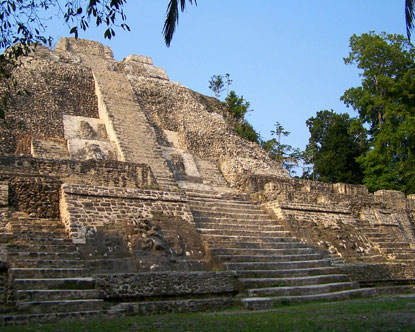
Suddenly our path opened onto the most picturesque Mayan ruins in Belize: Lamanai. There are three large pyramids, some restored stelae, and some open plazas, as well as a small but unique ball court. There are also the ruins of two 16th century Spanish churches nearby but we wouldn't have time to see them today. Lamanai was still occupied by the Maya when the Spanish arrived, so it is one of the few sites in Belize to preserve its traditional name. The large numbers of crocodile representations found in carvings seem to suggest that the animal had a very important role in the local mythology.
I was so excited to see "The High Temple". It was enormous, rising 108 feet (33 m) above the plaza level, built around 100 BC. Some brave souls were climbing it, but I was pretty hesitant. It looked a long way up! However, Steve said, we did not come all this way to stand around and look. The next thing you know I was holding onto a rope for dear life and panting my way up the crumbling stone steps. At the first plateau I did not dare turn around to look down or I knew I would lose my courage. I squeezed my fingers around that rope and started up the next level. There, I decided to risk a look around. My breath caught in my throat. The great panorama of the Belizean jungle laid out all around us, punctuated here and there with blue waters of rivers and cenotes. I knew I had to make it all the way to the top, just to say I had done it. With my legs shaking, I grabbed the rope and kept going. At last! Finally I was at the top! The view was even more amazing. I felt like a bird that had flown to the tallest tree in the forest. A few photo's later, we were so hot we had to get down. Thank goodness for that rope, because it is a long ways down! I would only recommend this climb to people who are very sturdy on their feet and fairly fit, or you could get into serious trouble.
Finally back on solid ground, we walked the short distance to the south of the High Temple ball court, the only one in Lamanai, dating to around 900-950 AD. It has a circular stone marker with a mysterious story…. It covers up a mysterious chamber where liquid mercury and several pieces of jade were found. Hmmm!
The Jaguar Temple (named because of a jaguar mask excavated here) is another of Lamanai's huge pyramids. It was initially constructed around 500-550 AD, but is twelve feet shorter in exposed height than the High Temple. It was amazing to hear that a large amount of this temple still lays unexcavated, the memories still buried deep under the ground. The MaskTemple is named after a 13 foot high carved mask of a humanized face with a crocodile headdress and dates to the late 5th to early 6th century.
There is still so much more at Lamanai to be discovered! Due to the cost of excavating archaeological sites, it may take many, many more years for the rest of the area to be revealed to us. I hope I am still around when the time comes, for this is one place I would love to return.
SOURCE


 AmbergrisCaye.com


 The Belizean Jungle and the Mayan ruins of Lamanai had always been an area I longed to see ever since I did an Essay in high school on the Mayan Civilization. As soon as I was old enough to travel on my own, I'd booked a trip to the Yucatan Peninsula. I explored the whole coast, all the way down to Tulum, experienced some fantastic bird watching in the Sian Ka'an Biosphere (the UNESCO World Heritage site) on the east coast of the Yucatan Peninsula, and then wandered around in awe in Tikal, one of the largest archeological sites of pre-Columbian Maya civilization in Guatemala. It took my breath away and ignited a spark in me to see more archeological and historic wonders in the world.